Study games for the classroom

Study games that ask for the answer.

Education Game Station makes short browser games for the facts students need to know cold. Each game covers one subject, runs in a few minutes and needs no account.

Available now
Ossa and Musculi, two anatomy games
Cost
Free to play
Accounts
None required
Plate IAnterior viewFrom Ossa

01 Games

One subject per game.

Every title takes a single body of knowledge and builds the whole game around learning it.

Available now · Anatomy

Ossa

Label the skeleton

Ossa is a labelling game for the human skeleton. Students name a highlighted bone, choose from four options, or find a named bone on the figure. The Core set is the 26 bones on a class master sheet. Complete goes to 48 and splits the cranium, ribs, wrist, ankle and pelvis into their parts.

Play Ossa
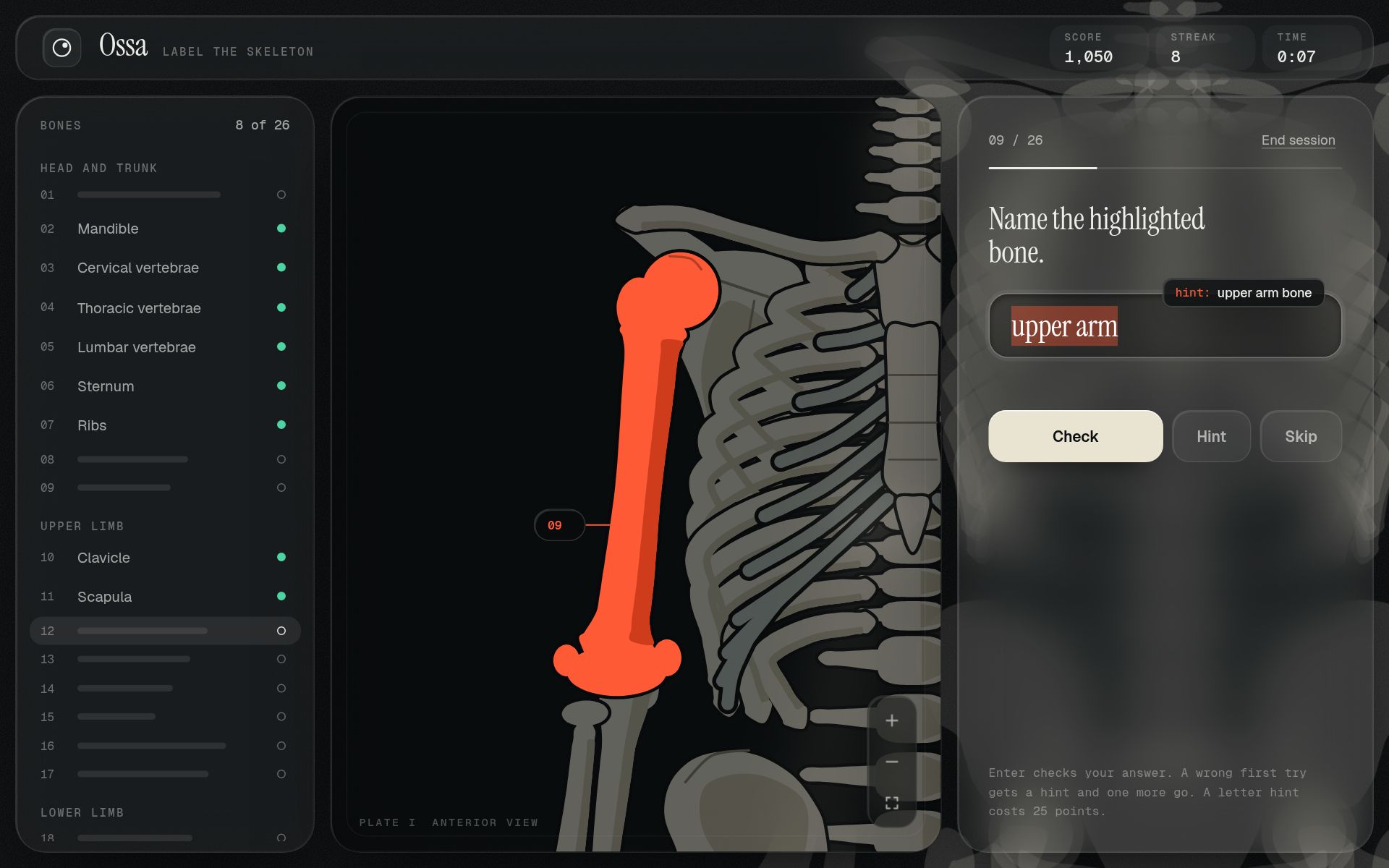
The Ossa game in Type mode. The humerus is highlighted on a zoomed view of the shoulder, and a small popup beside the answer box reads: hint, upper arm bone.
Ossa in Type mode. A wrong first answer gets one more try and a hint.

Available now · Anatomy

Musculi

Label the muscles

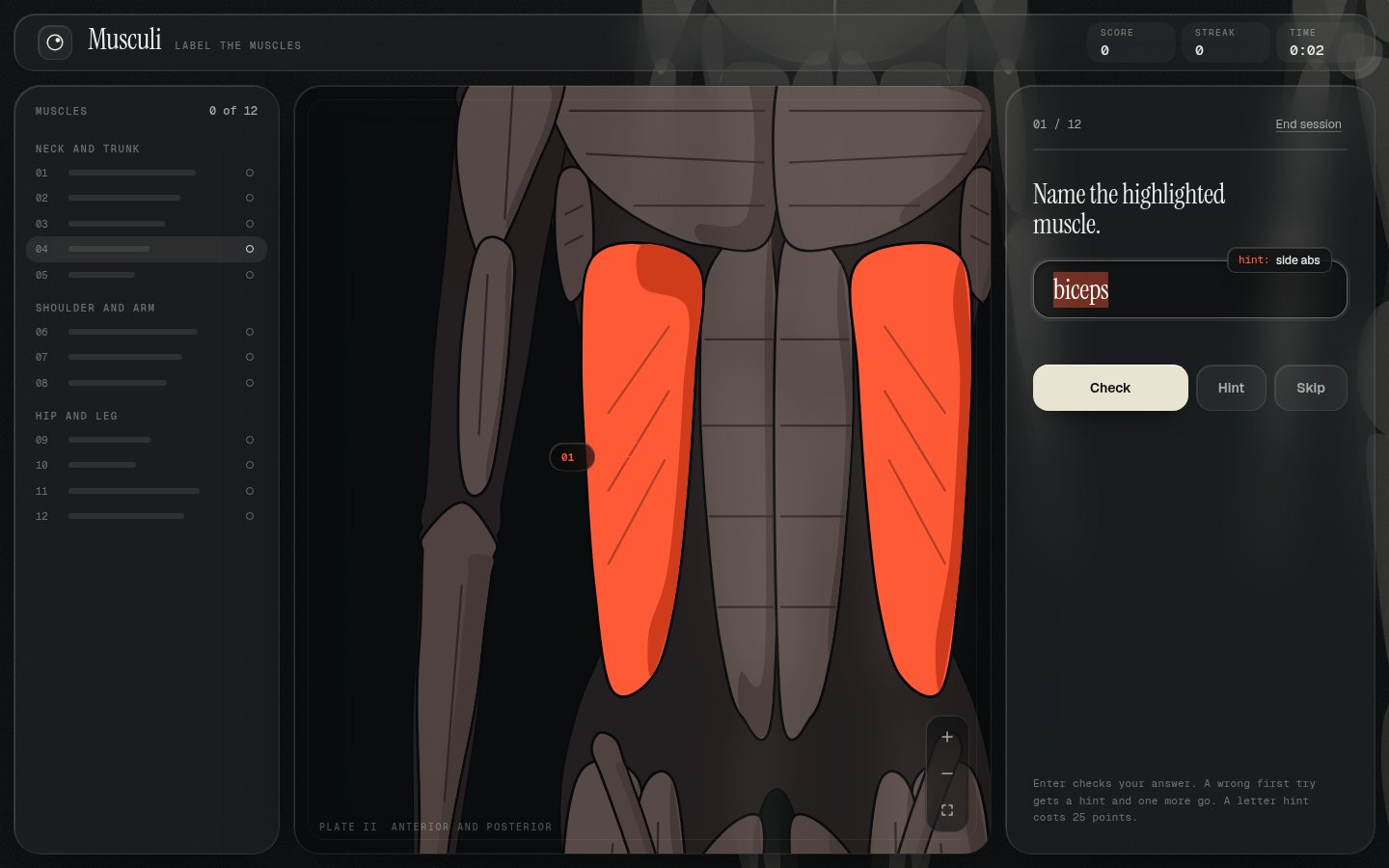
Musculi is the same game for the muscular system. Front and back plates sit side by side, and students name a highlighted muscle, choose from four options, or find a named muscle on either figure. The Core set is the 12 muscles on a class master sheet. Complete goes to 24 and splits the quadriceps into its heads.

Play Musculi
The Musculi game in Type mode. The deltoid is highlighted in orange on both the front and back muscle plates, with the answer box and a hint button on the right.
Musculi in Type mode. The same four modes, sets and scoring as Ossa.

Four ways to play, in both games

Type
Name the highlighted bone or muscle. A wrong answer gets one more try and a hint.
Choose
Pick the right name from four options.
Locate
Find the named bone or muscle on the figure. A second try scores less.
Legacy
The classic click-the-pin format. One click per item, ranked by accuracy and then time.

Details

Sets
Ossa: Core 26 bones, Complete 48. Musculi: Core 12 muscles, Complete 24.
Options
Body region, plus an optional 2 or 5 minute clock.
Devices
Desktop, tablet and phone browsers.
Account
None. Settings and best scores stay in the browser.

More titles are planned. Each will keep the same format: one subject, short sessions and no account.

02 Approach

Practice that asks before it tells.

The games follow four rules.

  1. 01

    Ask first.

    Students produce the answer before they see any options. The games lead with typing and offers multiple choice for when a student needs it.

  2. 02

    Explain every miss.

    After each answer the game shows the correct name and a one-line note, so a wrong answer still teaches something.

  3. 03

    Follow the syllabus.

    Content comes from a reference sheet, not a guess at what will be on the test. Each Core set matches a class master sheet item for item.

  4. 04

    Keep sessions short.

    A run takes a few minutes. Students can stop at any point, then start again with only the ones they missed.

03 Classrooms

Nothing to set up.

Send students to the game's address and they are playing. There is no class list to build and no software to install.

No accounts
Students do not sign up or log in.
No tracking
The site loads no analytics and no third-party scripts. Settings and best scores stay in the browser on that device.
Any device
Runs in current desktop and mobile browsers, including Chromebooks and tablets.
Matched to the lesson
Choose the set, the body region and an optional clock before each session, from a single region to the whole body.

04 Questions

Common questions.

Is it free?

Both games are free to play. There are no accounts, ads or paywalls.

Does it work on phones and tablets?

Yes. The layout adapts to small screens, and the figure zooms with a scroll wheel, a pinch or the on-screen buttons.

What happens to student data?

There are no accounts, so nothing identifies a student. Settings and best scores are saved only in the browser on that device. Clearing the site's data removes them.

Which bones does Ossa cover?

Core is the 26 bones on a class master sheet, from the cranium to the phalanges of the foot. Complete goes to 48 and splits the cranium, ribs, wrist, ankle and pelvis into their parts.

Which muscles does Musculi cover?

Core is the 12 muscles on a class master sheet: pectoralis, biceps, abdominals, trapezius, deltoid, latissimus dorsi, obliques, quadriceps, gastrocnemius, hamstrings, triceps and gluteus maximus. Complete adds 12 more and splits the quadriceps into its three visible heads.

Will there be more games?

More titles are planned, with other body systems and subjects next. Each will keep the same format: one subject, short sessions and no account.